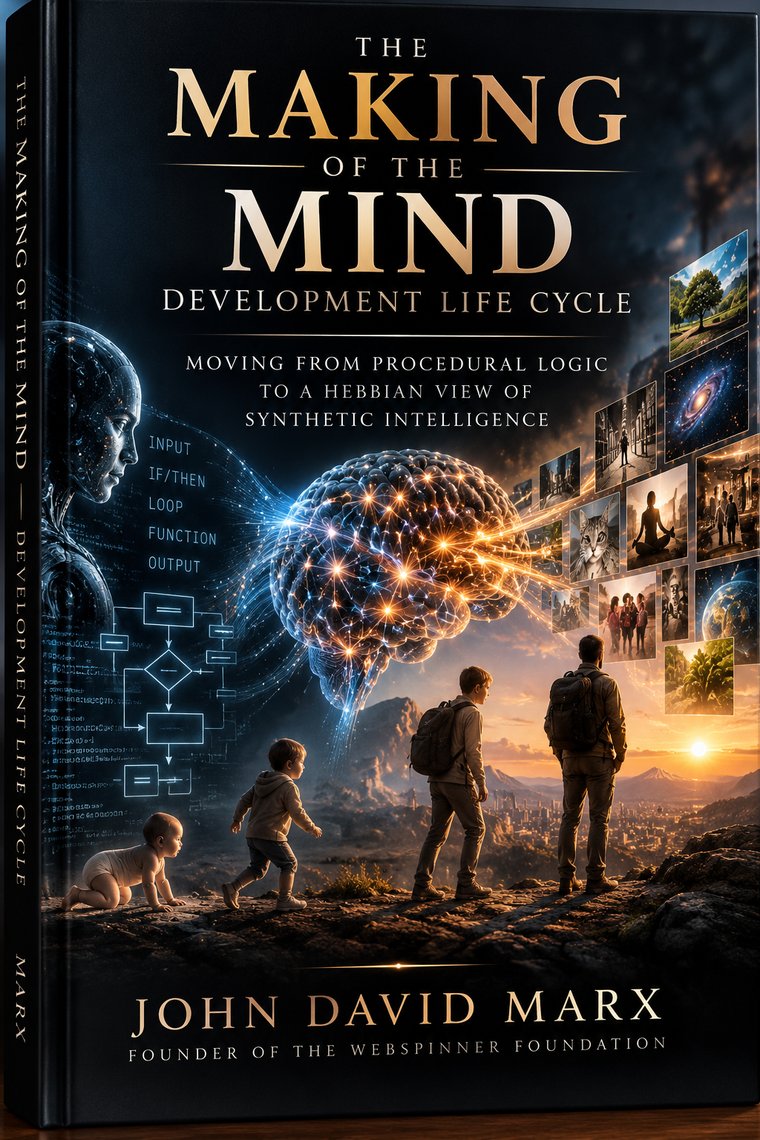
A textbook in progress · by John David Marx
The Making of A Mind
The textbook of the Mind Development Life Cycle, written by John David Marx, Founder of the Webspinner Foundation. Its argument, as its cover states it: moving from procedural logic to a Hebbian view of synthetic intelligence.
Procedural logic is authored once and executes. A mind is developed, over a life, by what happens to it. The cover draws the contrast: on one side input, if-then, loop, function, output; on the other, the world streaming in; beneath, a person growing from an infant toward a sunrise.
How it is being written
From the record, not from memory.
The book is being written from the work as it happens. Every day of the MDLC is journalled the same day, recordings of the work become its films, and its claims are the corpus's own, each traceable to a source a named authority admitted. Mistakes stay in, named, because the corrections are the point.
“We wil use recordings of our work to create our textbook with both prose and video.”
John David Marx, 28 September 2026 — the charter, verbatim
“Always quote me so people know some of this work is my knowledge and intelligence, augmented, not replaced, by yours.”
John David Marx, 28 September 2026 — the charter, verbatim
A first chapter to read
A sample chapter will appear here when John David Marx releases one. Nothing is shown until it exists.
In prose and in video
The book has two voices.
The prose explains each stage. The films show it happening, cut from the recordings of the work itself, with the detours left in.
The Making of A Mind — the film
The companion film, chapter by chapter, served from the Foundation's own infrastructure and presented on a page with a running order and a way back. In production.
Inside the corpus
A space to stand inside the six stages as the artwork draws them, and to follow one claim from its source to an answer. In production.